Friday, May 16, 2008

Through Female Eyes

“I have had to go to men as sources in my painting because the past has left us so small an inheritance of woman's painting that had widened life.... Before I put a brush to canvas I question, "Is this mine? Is it all intrinsically of myself? Is it influenced by some idea or some photograph of an idea which I have acquired from some man?"-Georgia O’Keefe


Sometimes when I am especially bogged down by homework and studying, like I am now during exam week, I reminisce about my days in kindergarten. Those were the days when life was divided into naptime, story time, snack time, and play time. Never did I have to worry about writing ten page papers and frantically cramming for finals.


One interesting thing I remember about kindergarten that is slightly more significant than the luxury of naptime is the kinds of activities available to us during our indoor play time. My best friend and I, along with a couple other girls, would always choose arts and crafts. We would engage in simple projects like coloring pages our teacher had printed for us or pasting white circles on construction paper to make snowmen, but almost never were we joined by a boy from the class. Looking back, this makes sense, as young boys are generally trained to think that some activities are more feminine and others, like sports, are more suited for them. Why then are women so underrepresented in the arts? I think almost anybody would be hard pressed to think of a female contemporary of Leonardo Da Vinci or Raphael. Even modern art is dominated by men including Picasso and Duchamp. For this reason, I find exhibits such as that by Paula Rego at the National Museum of Women in the Arts to be especially interesting.


Paula Rego is not only a leading contemporary female artist, but also a wonderful story teller. All of her paintings are narratives, based on literature, observation, experience, or imagination. Looking Out is the story of a woman who wastes her entire days looking out her window hoping to catch a glimpse of the priest with whom she had an affair. The Jane Eyre lithographs were inspired by the novel The Wild Sargasso Sea, which is about Bertha, a character in Charlotte Bronte’s masterpiece Jane Eyre. In addition, The Maids is an account based on Jean Genet’s play in which two sisters kill the woman they work for and try on her clothes.


While Rego’s primary goal may be to entertain viewers through the art of storytelling, as a woman painting women it is impossible for her messages to be completely separated from gender. As I see it, most of her works including the ones mentioned above serve as a commentary on the position of women in society. The woman in Looking Out has been condemned to a life of isolation and imprisonment because she got pregnant by a priest. Meanwhile, the man walks free without sharing the blame and continues his life like nothing ever happened. The Jane Eyre lithographs, on the other hand, portray a strong, brave, admirable character to which the entire female gender can look for inspiration. Meanwhile The maids is a psychologically intriguing depiction of women which gives some insight into the complexity of the female mind and emotions.


In a way, art by women such as Rego falls into a completely different realm than that of their male counterparts. Although artists, such as Leonardo Da Vinci and Picasso often painted women they, as men, were unable to capture female emotions and the truth of a woman’s experiences in a male dominated world. Therefore, Rego and other female artists have the potential to make monumental steps in the art world, while simultaneously depicting and criticizing the role of women in society and encouraging critical thought on the part of the viewer.

Baking Up A Storm

“To give life to beauty, the painter uses a whole range of colours, musicians of sounds, the cook of tastes—and it is indeed remarkable that there are seven colours, seven musical notes and seven tastes.” –Lucien Tendret


For a long time now, it has been my dream to go to culinary school. I would love to become a pastry chef and open my own small bakery where I would sell a variety of fruit and berry tarts, quiches, and cakes. Every time I watch the food channel, especially “Ace of Cakes” which is set in Baltimore’s Charm City Cakes, I long to be in the kitchen with the chef. I would be willing to perform even the most menial task to give my career a jump start.


Due to this baking passion, I was extremely excited when I heard about the opening of Georgetown Cupcakes. The two sisters who opened this shop have essentially fulfilled one of my highest aspirations. Although I have not actually tasted a cupcake yet, I have visited Georgetown since the bakery’s opening and been able to look in the shop window. It is a tiny, but cute little shop with an ideal location and the cupcakes which include flavors such chocolate banana, key lime, and lemon blossom look delicious. To be sure, long lines and early sell outs are a great testament to the quality of these cupcakes. Personally, I find the idea of a chocolate hazelnut or chocolate mint cupcake hard to resist.


While some people may deny that baking is an art, I beg to differ. A baker must design goods so that they are visually appealing. Taste means nothing if it does not look good enough to eat. In the case of a cupcake, decorating calls for the same care and precision that an artist uses when handling a brush. Attention to detail is also a must. Therefore, Georgetown Cupcakes has succeeded not only in developing a profitable business, but also in promoting an art form.

Tuesday, May 13, 2008

A Rainbow of Color

“The whole world, as we experience it visually, comes to us through the mystic realm of color.”-Hans Hoffman

One of my favorite things about DC is the great wealth of art made available to the public. I love going into the city to visit my favorite museums, and I actually enjoy getting museum paper assignments in my art history classes. Despite this, however, it is not so common for one of the exhibits shown in DC’s museums to have actually originated in the city. Nevertheless, this is the case with the exhibit Color as Field which is currently showing at the American Art Museum. Many of the artists whose works are on display, including Louis Morris, Kenneth Noland, and Gene Davis, actually lived and painted in Washington, DC. Therefore, when put into the context of its location, the exhibit is made doubly interesting.


As an art lover, I did not want to miss the opportunity to see art made by Washingtonians on display in a major Smithsonian museum. The exhibit’s title draws direct attention to color, and I was certainly impressed by the arrangement of colors I saw. The combination of pale pinks, greens, blues, yellows, and purples in paintings such as Morris’s Floral V creates a lively and upbeat atmosphere. Personally, I thought Morris’s color composition had a very soothing effect. Other pieces such as Noland’s Earthen Bound and Helen Frankenthaler’s Flood employ a similar blend of purples, yellows, pinks and greens to add to this ambiance. Obviously, color is an essential and crucially important aspect of this exhibit. Through color, these artists were able to break from traditional painting and create a distinctive genre for themselves. However, it is all too easy to become so wrapped up in the beauty and complexity of these color arrangements that the context and message are forgotten.


It was not until I thought about the dates of the art that I begun to fully understand its meaning. Many of the works are dated in the 1950s, the first full decade following the end of World War II. During this period, America was marked by a universal relief due to the end of the war. The country was finally returning to normal status after decades of turmoil as reflected by the attitudes of its people. Furthermore, the world wars functioned as economic stabilizers, paving the way for a time of comfort and hope. Considering this historical context, it is easy to see that the bright colors and cheerful compositions of Color as Field were in response to the state of society and a reflection of the people’s general mindset.


The works of these artists prove that color can be very powerful. While it can and should be valued for its beauty, it also needs to be considered for its deeper connotations. It can depict a feeling or state of mind and evoke certain emotions. It can be a reflection on the condition of society or commentary on past events. In displaying this particular exhibit, the American Art museum shows that color can truly be the ultimate form of expression.

Monday, May 12, 2008

Hidden Pictures

“What a funny thing painting is. The abstract painters always insist on their connection with the visible reality, while the so called figurative artists insist that what they really care about, is the abstract qualities of life.”-Marlene Dumas

I know quite a few people who don’t like abstract art at all. It is easy to understand why a person would rather appreciate art simply for its beauty than remain puzzled as they attempt to interpret an abstract piece. Although I do like abstract art, especially painting, I sometimes find it frustrating to look at a particularly baffling piece. While I am aware of the aesthetic qualities of such art, there are times when I just cannot understand the artist’s meaning or recognize a figure that is supposedly hidden amidst a random assortment of colors and lines.

For these reason’s, I went to Amy Sillman’s exhibit, Third Person Singular, at the Hirshorn not knowing what to expect. Therefore, I tried to learn as much as I could about the artist from the wall posts and descriptions at the museum before I actually looked at the works. As it turns out, Amy Sillman is a New York artist who tries to express emotion and anxiety through a very abstract style. She began the work in this exhibit by sketching numerous couples, sometimes using models and sometimes from memory. The bulk of the works, however, are paintings inspired by these couples. According to one of the wall posts, “Her works embrace abstraction without abandoning representation, as the details of the figures are shrouded behind bold strokes and geometric forms.” Now, maybe it’s just me, but I had trouble finding the figures in many of her paintings. It wasn’t until I got home and looked at some of the works again with my friends that I began to see things in them.
At first, I thought this was a shoe and the purple was a pant leg. However, a friend pointed out that a dark spot near the center of the shoe resembled a face and that the purple could be a billowing cape worn by this figure.
To me, this looks very much like a window. Outside the window I see a blue sky and a red and white sale boat with a rectangular sail. However, after staring at it for awhile I saw what seems to be a cupped hand at the bottom of the window sill.
This is one of the most abstract pieces of the exhibit in my opinion. Maybe the bottom right corner is a body of water and the lighter blue and white represent a ship coming toward the viewer. When it comes down to it though, I cannot identify many objects in this piece. Can you find the hidden figure in this painting?

It is very curious to me that all of these images were inspired by couples which in Sillman’s sketches are very recognizable as people. I have given considerable thought to the Hirshorn’s exhibit in the past couple of weeks. Maybe, Sillman is reflecting on our dynamically changing society and the shifting status of individuals and relationships in this society. It is possible that relationships as we traditionally think of them are becoming more abstract. It is not uncommon to see two people having lunch together while talking on their cell phones. Sometimes, relationships can be developed on the internet without any real human contact at all. The recent popularity of facebook and texting make both of these incidents even more frequent. Even blogs can be a to testament the abstraction of relationships. Blogs are an easily accessible forum for conversation which create group relationships with a very different feel than those developed in small living room gatherings. I do not know if Amy Sillman thought at all about these things when painting, and I may never fully understand the message she intended to convey. However, abstract art as my friends and I discovered, can have unlimited interpretations, and for now I choose to believe that Sillman’s art is a commentary on relationships in modern society.

A Day At the Zoo

I will admit from the start that I don’t find very many artistic aspects about a zoo. Even I, a person who sees art in basketball and graffiti, don’t consider small children looking at caged animals an art form. Nevertheless, I do enjoy a nice day at the zoo. In fact, I went to the National Zoo just a couple of weeks ago with my sister. We spent about five tense minutes watching a tiger try to catch a bird for its lunch, and I could have spent the entire afternoon staring in amazement as the sea otters did repeated underwater summersaults. Some parts of the zoo are currently closed for renovations, but we were still able to observe the giant panda, cheetahs, lemurs, and a assortment of other animals.

So I bet you are wondering why I am talking about the zoo in a blog about art. Well, it just so happens that the National Zoo in Washington, DC, is part of the Smithsonian, the same institution that funds the National Gallery, the National Portrait Gallery, and a slew of other wonderful museums. While this connection may be minor and somewhat insignificant, it still exists. Like all the Smithsonian art exhibits mentioned in this blog, the National Zoo is absolutely free. So why not use that as an excuse to spend a day at the zoo and maybe even check out one of the Smithsonian museums while you’re at it.

Thursday, May 1, 2008

Redefining Art

“You are Just, if there is a Just, trying to be an artist. You are Just trying to show the beautiful soul of your people.”- Nikki Giovanni

A few days ago I was riding back from DC to College Park on the metro. As the train was pulling into the Fort Totten Station, I noticed a cement wall covered in graffiti outside my window. Placed in a very prominent position in huge burgundy and gold letters was the name Sean Taylor and the number twenty-one. Surrounding it were various other tags and phrases such as “Go Hilary”. Until then I had never given much thought to graffiti. In school we were always told that graffiti was vandalism and wholly dishonorable. I never really stopped to think that graffiti could be a tool for self expression, a way to honor a local hero, or a voice on political viewpoint.

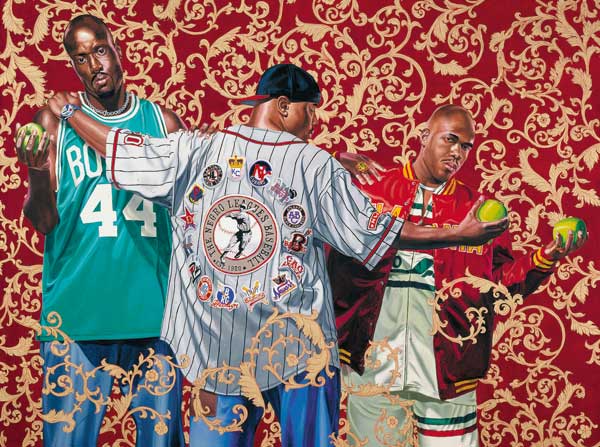
As I continued to contemplate, I was reminded of an exhibit I had recently seen at the National Portrait Gallery titled Recognize: Hip Hop and Contemporary Portraiture. As its title suggests, this exhibit is a display of portraits of prominent individuals in popular music and sports: LL Cool J, Ice T, and Big Daddy Kane to name a few. The exhibit obviously focused on the portraits of these figures, mostly paintings by the artist Kehinde Wiley. Unlike most monotonous portraits painted against plain backgrounds, these were puns on famous historical portraits and images of legendary figures. For example, one painting placed three pop-culture celebrities together under the title Three Graces. In another titled Ice T Channels Napoleon, Ice T adopts the regal pose of the Napoleon. To me, however, one of the most interesting things was the gallery hallway in which the walls were covered with graffiti designed especially for this show. It was this memory which encouraged me to think about the graffiti outside the Fort Totten Station.

In the music world, some types of music are much more highly regarded than others. Some people may not even think of rap or hip hop as music. The same is true in the art world in which some works are thought of as high art and others as low. Graffiti, if it is art (and I do think it is,) is certainly on the low side. The National Portrait Gallery, however, challenges these ideas by bringing pop culture icons and graffiti into the high art realm known as the museum. Portraits such as Ice T Channels Napoleon suggest that a rap star is just as worthy of lasting recognition as Napoleon. Similarly, the graffiti panels in the hallway suggest that graffiti can be as aesthetically pleasing and thought provoking as other highly praised art forms.

Museums definitely play a role in shaping the way the public views art. At times, a museum can even alter a viewer’s perception of culture. In this particular exhibit, The National Portrait Gallery shows the significance of popular culture and questions the current understanding of art. If the goal of this exhibit is to make people think about graffiti and its role in modern culture, then it certainly succeeds. I myself am proof of this. But does simply placing something in a museum make it art? Should museums have the sole authority to label something as art? If graffiti in the National Portrait Gallery is art, then the name Sean Taylor on a cement wall is also art. Right? So who decides?

Wednesday, April 30, 2008

Who is El Anatsui?

“Art grows out of each particular situation, and I believe that artists are better off working with whatever their environment throws up.” -El Anatsui

A few weeks ago, the professor of my African Art class offered all of her students an opportunity for extra credit. All we had to do was visit El Anatsui’s Gawu Exhibit at the National Museum of African Art and three points would be added to our final class grade. This sounded like a pretty good deal to me. So I went to the museum, but with a more reluctant spirit than I would have had were I going to almost any other.

Normally, I would have been excited to look at one of my favorite pieces of art again or to see something entirely new. At the very least, I would look forward to getting out of College Park for a few hours and spending some time in DC. However, African Art has never been my favorite artistic genre. I would much rather look at one of the idealized, romantic scenes of a Fragonard painting than an African tribal mask by some unknown artist.

When I first entered the exhibit, however, I was somewhat taken aback by the monumentality and uniqueness of the works. A moment after my initial surprise, I was able to take in the entire room. My eyes were initially drawn to what appeared to be a small mountain range constructed entirely of peak brand milk cans. The room was divided into two sections by a massive wall constructed of long, flat steel sheets. The normally white walls of the gallery seemed to be covered in huge colorful cloths. Only with closer examination did I realize that what appeared to be soft, moveable kente cloth was actually numerous pieces of aluminum held together with copper wire. Needless to say, I was amazed.


I knew a little bit about El Anatsui before going to the Gawu exhibit, but not enough to capture the true essence of his work. My professor had told us the El Anatsui was an artist from Ghana who used recyclable material in his sculptures to comment on a loss of tradition and a new culture based on material goods. When El Anatsui actually came to my art class to speak he explained to inquisitive students that he simply used whatever materials presented themselves to him. El Anatsui’s work has traveled around the world, and his social commentary is one that can be universally understood. Why then I wonder is African art so frequently ignored in the art world? There is absolutely nothing about him in my massive African Art textbook. Furthermore, why shouldn’t his work be studied in classes on modern art as well?

It is hard to say that African art is underappreciated considering there is an entire Smithsonian museum dedicated to it. But then again, maybe it is. I admit that I probably would have been more likely to visit this exhibit on my own accord had it simply been labeled modern art and put on display at the Hirshorn. Unfortunately, I imagine there are many other museum goers who secretly feel the same. While El Anatsui’s African heritage adds a vital element to his work, its message might be more widely received were his works considered in a different light. After all, if Duchamp can be famous for turning a urinal on its side then why is El Anatsui not more well known? It seems to me that the art world is really missing out by undermining the importance of El Anatsui’s work and probably that of many other African artists as well. Maybe now, after this eye opening experience, I will think twice before going to see my favorite paintings for the hundredth time. I may even go back to the National Museum of African Art to see what else so called “African Artists” have to offer.